

My Dress-Up Darling XOXO shines when it sticks to Kitagawa and Gojo

Share
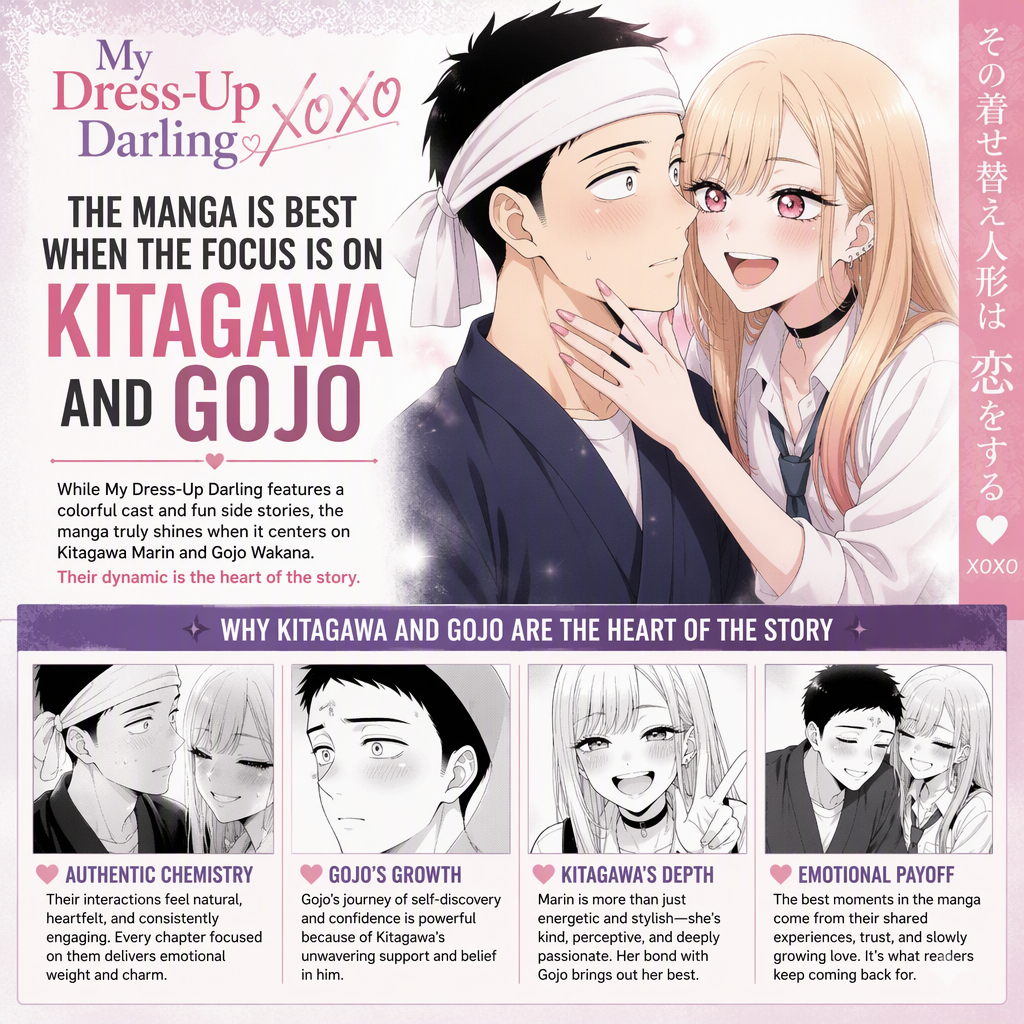
🎮 AI-drawn 可愛い fan art 'ish. No humans were harmed in the render
Chemistry > Filler 💃🏾
Kitagawa and Gojo are the heart of My Dress-Up Darling XOXO, but let’s not act surprised. Black anime fans know that chemistry carries a story, and when side characters start feeling like filler, it’s time to refocus on the leads. Give us the sparks, not the scraps.
🌟 ✨ Character Spotlight Lens
Let’s talk about who really gets to be the main character in these stories. My Dress-Up Darling XOXO is the latest entry in the franchise, and it knows its strengths: the chemistry between Marin Kitagawa, the bubbly, self-assured cosplay queen, and Wakana Gojo, the shy, deeply skilled artisan who’s still figuring out how to take up space. Whenever the focus shifts squarely to them, the manga shines. But here’s the question we should ask anytime we see a story built around this kind of dynamic: who’s being centered, and whose labor is holding everything up?
On the surface, My Dress-Up Darling seems like a sweet, uncomplicated love letter to creative collaboration. Marin dreams big, Wakana makes the magic happen, and through cosplay, they get to build a world together that neither of them could alone. But if you dig into the structure of these kinds of stories, you’ll notice a pattern that feels familiar well beyond the pages of manga. Marin’s joy, confidence, and personality dominate the narrative. She’s charismatic, she’s loud, she’s vibrant, and all of that makes her lovable. Meanwhile, Wakana’s quietness and hesitance leave him occupying a different role: not the co-star, but the foil, the foundation for Marin’s brilliance to shine even brighter.
It’s hard not to see echoes of how labor, creativity, and visibility play out in real life, especially in Black communities, where we know what it means for one person’s voice to get amplified while someone else’s hands are doing the heavy lifting. Wakana’s artistry is the whole engine driving Marin’s success as a cosplayer. His skills are what turn her ideas into reality, but the story treats his effort like background noise, something to be appreciated in passing rather than celebrated as the core of what makes their partnership special. Sound familiar? It’s the same way so much Black genius gets erased behind the scenes while someone else, often someone louder, flashier, more marketable, basks in the spotlight.
On the surface, My Dress-Up Darling seems like a sweet, uncomplicated love letter to creative collaboration.
That’s not to say Marin is undeserving of her shine in the story. She’s bold and unapologetic, and it’s refreshing to see a character who owns her quirks and her passion without trying to shrink herself. But Wakana’s quieter brilliance feels so much deeper and more resonant. He’s someone who’s wrestling with self-doubt, who’s carrying emotional baggage from a past where he was teased for loving something untraditional, and who’s finding ways to express care for others through his craft. It’s his journey that has the most to teach us, especially for those of us who have ever been asked to put our heads down and work while someone else gets the credit. That experience hits different when you’re Black, when your contributions are constantly undervalued, when your effort is treated as invisible even while people are quick to consume what you’ve created.
So what’s the takeaway here? My Dress-Up Darling is better when it remembers that Wakana’s quiet artistry is not just a backdrop for Marin’s sparkle. It’s the heart of the story. And in real life, we need to make sure we don’t fall into the same trap of elevating the loudest voices at the expense of the quieter ones who make everything possible. Marin and Wakana may be fictional, but the dynamics their relationship reveals are all too real. Let’s not let charisma outshine craft. Both deserve their flowers, and Wakana’s hands? ✊🏾
🧵 Threads of Romance 💕
My Dress-Up Darling XOXO proves that when romance meets cosplay, the real magic is two awkward hearts stitching themselves together.
💡 Craft Meets Culture 🪡
Black cosplayers and creators have been elevating anime culture for years, and seeing a series like My Dress-Up Darling focus deeply on craft and connection hits differently. Kitagawa and Gojo’s journey isn’t just about costumes, it’s about passion, artistry, and mutual respect, values Black artisans know well in spaces where recognition often lags behind contribution.